Your Yard is a Swamp: Fixing Standing Water in Your Backyard (5 DIY Solutions)

If you live in Washington state right now, I feel for you. The news says you just got hammered with historic rain. But even if you aren’t dealing with a catastrophic flood, a lot of us are dealing with the annoying aftermath of winter storms: a backyard that looks like a soup bowl.
Squish. Squish. Squish.
That is the sound of your lawn dying. It’s also the sound of mosquitoes planning their spring vacation on your property.
If you are tired of ruining your shoes and smelling that stagnant, rotten-egg odor, you need to act. We aren’t calling a contractor yet. We are going to look at fixing standing water in your backyard with some elbow grease and common sense.
Here is how you dry out the swamp without going broke.
Why Your Yard is Holding Water (The Culprits)
Before you start digging trenches, you need to know why the water isn’t moving.
Usually, it is one of three things:
- Grade: Your yard slopes the wrong way (towards the house or into a bowl).
- Soil: You have heavy clay soil that acts like a ceramic bowl.
- High Water Table: The ground underneath is already full.
If it’s the water table, you might need a sump pump. But for the first two? We can fix that.
Solution 1: Extend Your Downspouts (The $20 Fix)
I see this every day. You have a massive roof. All that rain hits the roof, goes into the gutter, and dumps right at the corner of your foundation.
Of course you have a puddle there. You are literally piping water into a hole.
Go to the hardware store. Buy a downspout extender. They are cheap, plastic, and ugly. I don’t care if they are ugly. Run that water at least 6 to 10 feet away from your house.
If your gutters are clogged, none of this matters. The water is just spilling over the sides like a waterfall. Read our guide on Fix Standing Water in Gutters before you do anything else. If the gutters are full, the yard will never be dry.
Solution 2: The French Drain (The Heavy Lifter)
This is the classic DIY backyard drainage solution. It works, but it is back-breaking work.
A French drain is just a trench with a perforated pipe inside, surrounded by gravel. The water takes the path of least resistance (the gravel), falls into the pipe, and flows away.
The “Lite” Version:
- Dig a trench about 18 inches deep where the water pools.
- Line it with landscape fabric (permeable).
- Put in 2 inches of gravel.
- Lay down a 4-inch perforated drain pipe.
- Cover with more gravel.
- Fold the fabric over and cover with topsoil/sod.
Is it worth it? If you have a serious low spot, yes. But be warned: French drain installation cost can creep up if you have to buy a lot of gravel. And your back will hate you tomorrow.
Solution 3: Aerate Your Lawn (The “Lazy” Fix)
Sometimes, the problem isn’t the slope. It’s the dirt.
If your soil is compacted—meaning you’ve been walking on it, parking on it, or the builder just graded it with a bulldozer—water can’t get through. It sits on top like it’s on concrete.
Rent a core aerator. Not those silly spike shoes you strap to your boots. A real machine that pulls little plugs of dirt out of the ground.
This punches holes in the “crust” of your yard. It lets air in and water down. If you have backyard drainage solutions for heavy clay soil on your mind, this is step one. It helps the soil breathe.
Solution 4: The Dry Creek Bed (The Pretty Fix)
If you can’t beat the water, make it look like you planned it.
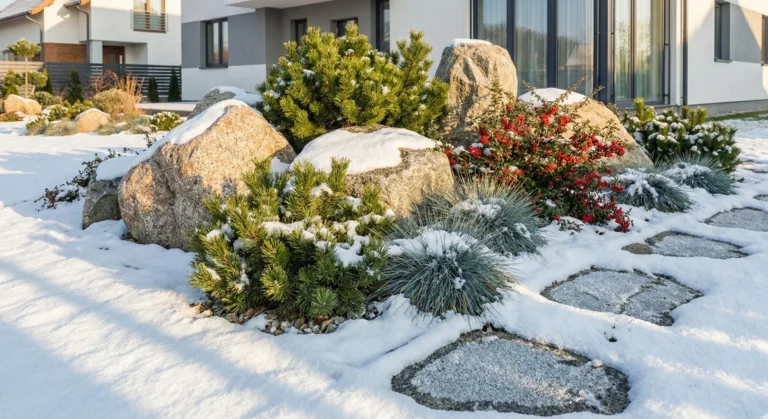
A dry creek bed is basically a gully lined with river rocks. When it rains, it acts like a channel to move water from the puddle spot to a lower spot (or a storm drain). When it’s dry, it looks like a nice landscaping feature.
- Dig a shallow, meandering path.
- Line it with landscape fabric.
- Fill it with stones of different sizes (boulders on the edges, river rock in the middle).
It stops erosion and hides the mud. Plus, it adds “curb appeal,” whatever that means.
Solution 5: The Rain Garden (The Eco-Fix)
This is my favorite because it requires the least amount of ongoing maintenance.
Instead of fighting the puddle, turn the puddle into a garden. A rain garden is a shallow depression planted with deep-rooted native plants that love water (like Swamp Milkweed, Ferns, or Blue Flag Iris).
According to Clemson University Extension, a rain garden can absorb 30% more water than a standard lawn. The roots act like straws, sucking the water down into the subsoil.
Dig out the low spot a bit more, mix in some sand and compost to loosen the clay, and plant your water-loving plants. They drink the water for you.
Don’t Overthink the Water
Sometimes, a wet spot is just a wet spot because you are overwatering. I know, it sounds dumb in winter, but I’ve seen people run sprinklers after a rainstorm.
Check your irrigation. If you are dumping water on an already saturated lawn, you are asking for fungus and rot. Check out our Does Overwatering Your Lawn Cause Brown Patches Complete Guide to see if you are the problem.
Quick Answers (Because I Know You’ll Ask)
“How do you fix a swampy yard cheaply?” Extend your downspouts ($20) and aerate the lawn ($60 rental). Most swampy yards are just bad roof runoff management combined with hard dirt.
“Does aerating help with drainage?” Yes, but only for surface water. If you have a literal underground spring or a high water table, punching holes won’t fix it. But for rain puddles? It works wonders.
“Will standing water go away on its own?” Eventually. But while you wait, it breeds mosquitoes (takes 7 days) and kills your grass roots (takes about 4 days). Don’t wait. Broom it off if you have to.
The Bottom Line
You don’t need to live in a bog. You don’t need to wear rubber boots to get to your mailbox.
Pick one of these fixes. Start with the downspouts because it’s the easiest. If that fails, dig the trench. Just get the water moving, or you’re going to be fighting mold and pests all spring.
Get to digging.