Your Sprinklers Are About to Explode: How to Prevent Frozen Pipes in Your Garden Sprinkler System (Winter Guide)
It’s December. The wind is howling. The news is screaming about a “polar vortex” or some other terrifying weather event hitting the Northeast and Midwest. And while you’re busy buying milk and bread like the world is ending, you’re forgetting the one thing that’s actually going to cost you money.
Your sprinkler system.
Look, I get it. Nobody wants to think about lawn care when it’s 20 degrees outside. You want to sit by the fire. But if you don’t learn how to prevent frozen pipes in your garden sprinkler system right now, you are going to wake up in April to a cracked manifold and a $1,200 plumbing bill.
I’m not here to hold your hand. I’m here to save you from being the guy who floods his own basement because he was too lazy to turn a valve.
Let’s get to work.
Why You Need to Care (It’s About the Money)
Water expands when it freezes. It’s simple physics. It doesn’t care that your PVC pipe is “heavy duty.” It doesn’t care that you “buried it deep.”
When that water turns to ice inside a confined space, it pushes outward with incredible force. Boom. Cracked pipes. Smashed valves. Ruined sprinkler heads.
According to the City of Englewood’s utility department, even a single night below freezing can do the damage. And fixing it? It’s not cheap. A professional repair job for a burst main line can easily run you hundreds of dollars.
So, spend an hour now, or spend a paycheck later. Your choice.
Step 1: Shut It Down (The Obvious Part)
First things first. You need to stop the water source.
Go to your main water shut-off valve. This is usually in the basement, the crawl space, or sometimes in a utility box outside. If it’s outside and you live in the North, good luck finding it under the snow.
Turn it off.
Now, go to your sprinkler controller—that plastic box in the garage you never touch. Turn the dial to “OFF.” Don’t just unplug it; some of those things have backup batteries and will try to run a cycle on dry pipes, which burns out the solenoids. Just switch it to “Rain Mode” or “Off.”
Method 1: The Manual Drain (The Hard Way)
If you have an older system, you probably have manual drain valves. These are little levers or caps located at the lowest points and the ends of your piping.
- Put on your boots.
- Find the valves.
- Open them.
Water will drain out. Gravity does the work here. But here’s the catch: Gravity isn’t perfect. If your yard has dips and valleys, water gets trapped in the low spots. That water freezes. That pipe bursts.
If you use this method, you better be sure your system was installed on a slope. If not, you’re gambling.
Method 2: The Auto-Drain (The Lazy Way)
Some of you have “automatic” drain valves. These are installed at the low points of the system and open up automatically whenever the pressure in the pipes drops below a certain level (usually 10 PSI).
Ideally, you just shut off the main water, run one sprinkler cycle to release the pressure, and the valves do the rest.
Do I trust them? No.
They clog with dirt. Roots grow into them. If one fails, you won’t know until Spring when you see a geyser in your front yard. If you have these, I still recommend the next method just to be safe.
Method 3: The Blowout (The Fun, Dangerous Way)
This is the gold standard. Winterizing a sprinkler system DIY style usually means blowing the water out with compressed air.
But listen to me closely: Do not use your little tire-inflator compressor.
You need high volume, not just high pressure. You need a compressor that can push 10-25 cubic feet per minute (CFM). Those little pancake compressors in your garage? They’ll just pressurize the water without moving it, which can actually blow up your gears.
The Process:
- Safety First: Wear ANSI-approved eye protection. Seriously. I’ve seen plastic caps fly off like bullets.
- Connect: Hook the compressor to the blowout port (usually near the backflow preventer).
- Slow and Steady: Turn on the compressor. Do NOT go over 80 PSI for PVC pipe or 50 PSI for polyethylene.
- Cycle Zones: Activate one zone at a time from the controller. Watch the heads pop up.
- The Mist: As soon as the water stream turns to a fine mist, stop. Don’t run it dry for minutes; the friction will melt your plastic gears.
If this sounds terrifying, just pay a pro. The sprinkler blowout cost is usually $75-$150. Cheaper than a hospital visit.
Protect the Backflow Preventer
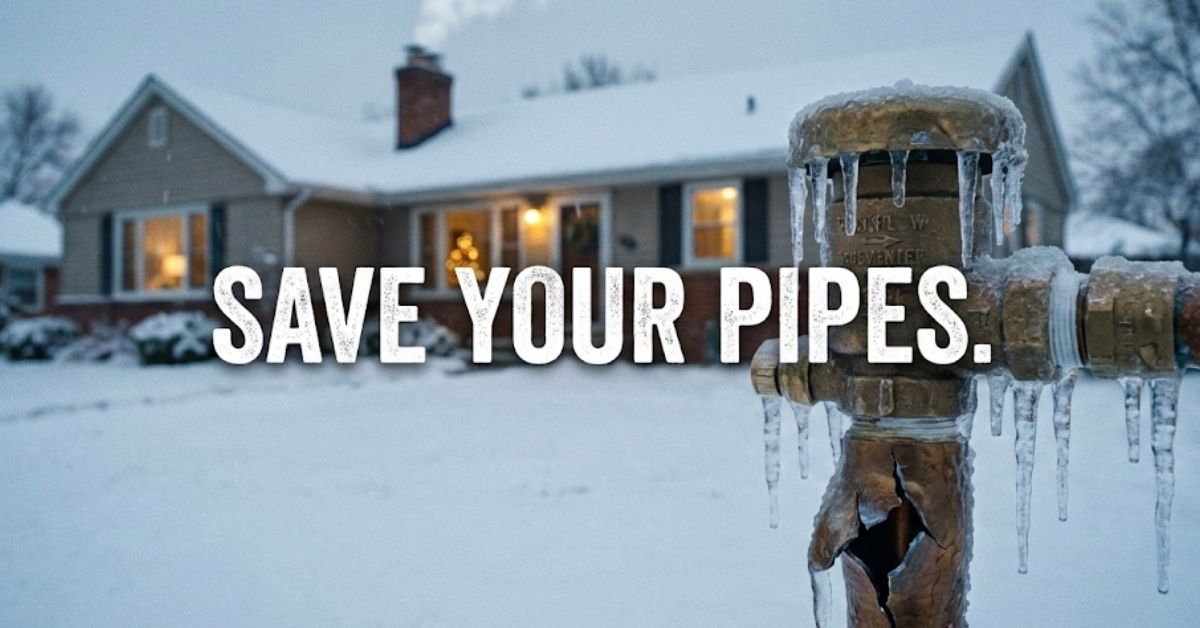
This is the brass contraption sticking out of the ground near your house. It prevents dirty yard water from backing up into your drinking water. It is expensive. It is fragile.
If you can’t remove it (some are unionized and come right off), you need to insulate it.
Buy some foam insulation tape. Wrap it like a mummy. Or buy one of those fake rock covers if you care about aesthetics. Just keep the wind off the brass.
A Note on “Freezing Rain”
We aren’t just talking about underground pipes. We’re talking about the stuff above ground too.
We just saw a massive storm hit the Northeast with ice and snow. If you have exposed hose bibs or dripping valves, freezing rain will encapsulate them in ice, expanding and cracking the metal.
Check out our guide on how to protect plants from freezing rain. The same logic applies to your pipes: cover them up and keep them dry.
Also, while you’re out there freezing your toes off, take five minutes to check your lawn health. A winter burn is real. Read up on this 5-minute task to save your lawn from winter burn. It’s worth your time.
Quick Answers (Because I Know You’ll Ask)
“Do I really need to blow out my sprinklers?” Yes. Unless you live in Florida or Southern California. If the ground freezes where you live, the water in your pipes freezes. End of story.
“Can I winterize my sprinklers myself?” Sure. If you have a big enough air compressor and you know what a “backflow preventer” is. If you don’t, you’re going to break something. Just hire a guy.
“At what temperature do sprinkler pipes freeze?” 32°F (0°C). That’s the freezing point of water. But usually, you have a buffer until the air hits about 28°F for a few hours. The ground insulates the pipes for a while, but don’t push your luck.
The Bottom Line
I don’t like writing checks to plumbers. I assume you don’t either.
Take an hour this weekend. Drain the system. Blow out the lines. Wrap the valves. Then go inside, make some hot cocoa, and ignore your yard until March.
Stay warm.