Are Your Holiday Lights Safe? The Fire Risk Experts Are Warning About Now
You know the drill. It’s December, and you are digging through a dusty plastic bin in the garage, untangling a ball of lights that worked perfectly last year. You plug them in, they light up, and you think you’re good to go.
But this year, experts are sounding a different alarm.
It isn’t just about old, frayed wires anymore. The biggest fire risk for the 2024 holiday season might be sitting in your online shopping cart right now. If you bought a “bargain” set of lights from a massive online marketplace or a third-party seller, you need to read this before you hang a single strand.
Here is what safety experts are warning about right now, and how to keep your home from becoming a statistic.
1. The “Mr. Christmas” Recall Warning
Let’s start with the immediate news. Just days ago, federal safety regulators issued a recall for a specific wireless tree light controller sold at major retailers like Target and Walmart. The Mr. Christmas (and “Wondershop”) wireless controllers can overheat, posing a genuine fire hazard.
If you have a little white box that lets you turn on your tree wirelessly, check the model number immediately. If it’s on the list, unplug it. Do not use it. This is a reminder that even big-box store items can have defects, but the real Wild West is online.
2. The “Online Marketplace” Trap
We all love a deal. But if you bought a 100-foot strand of LED lights for $9.99 from a site like Temu, Shein, or a random Amazon third-party seller, you might have bought a fire starter.
Safety inspectors are finding that these cheap, direct-from-overseas lights often skip mandatory safety testing. They use wires that are too thin to handle the electrical current. They lack fuses. They might look fine, but after two hours on your dry Christmas tree, they can melt.
The Rule: If the price seems too good to be true, it is. Stick to established brands sold by reputable hardware stores.
3. The Red vs. Green Label Test
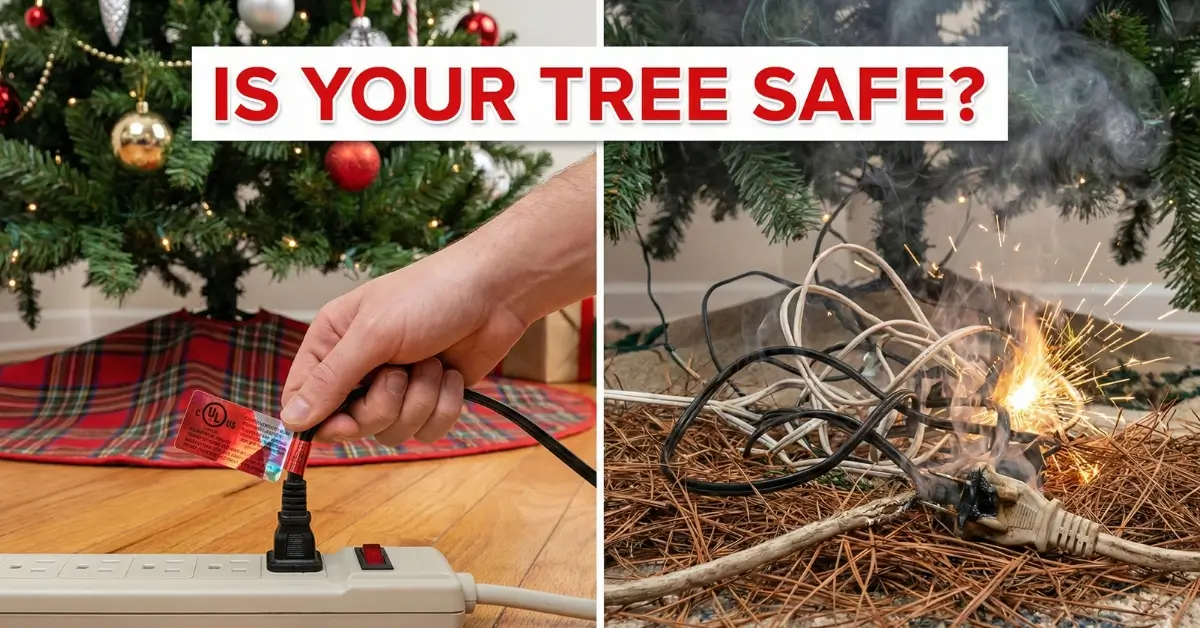
Go look at the tag near the plug of your light strands. You should see a holographic UL (Underwriters Laboratories) label.
- Green Label: This means Indoor Use Only. These lights cannot handle moisture or temperature swings. If you put these on your porch, one damp night could cause a short circuit.
- Red Label: These are rated for Indoor/Outdoor Use. They are tougher, sealed against moisture, and safe for your bushes.
- No Label? If there is no holographic tag, or if the tag looks like a cheap sticker with typos, throw them away. Immediately. It means the product was never safety tested.
4. The “Daisy-Chain” Danger
This is the most common mistake I see neighbors make. You need to reach the far end of the roof, so you plug one strand into another, and another, until you have six sets linked together.
This is called “daisy-chaining,” and it is dangerous.
Most standard light strings are only designed to connect up to three strands maximum. When you connect more, the electrical resistance grows. The first strand in the line has to carry the power for all the others. It gets hot. Eventually, the insulation melts.
- The Fix: Use a heavy-duty outdoor extension cord and split the load. Plug separate runs of lights into a power strip (protected from the weather) rather than linking them all in one long snake.
Also Read: WARNING: Never Hang Christmas Lights This Way (It Kills Your Trees)
5. The Hidden Battery Hazard
“Fairy lights” (those tiny LEDs on thin copper wire) are trendy right now. But watch out for the battery packs.
Recent warnings have highlighted that many cheap fairy light sets use button batteries (coin cells) in compartments that aren’t secured with screws. If a battery cover pops off, those shiny little batteries look exactly like candy to a toddler or a pet. Swallowing one is a life-threatening medical emergency.
Bottom Line
Your holiday display should be dazzling, not dangerous. Take ten minutes to inspect your gear. Check for the UL label, ditch the cheap online knock-offs, and if a wire looks chewed or cracked, don’t tape it. Toss it.
If you are looking for more ways to upgrade your outdoor space safely, Fit For Yard has guides on everything from lighting to landscaping. And for the latest updates on product recalls and safety alerts, keep an eye on our News section throughout the season.